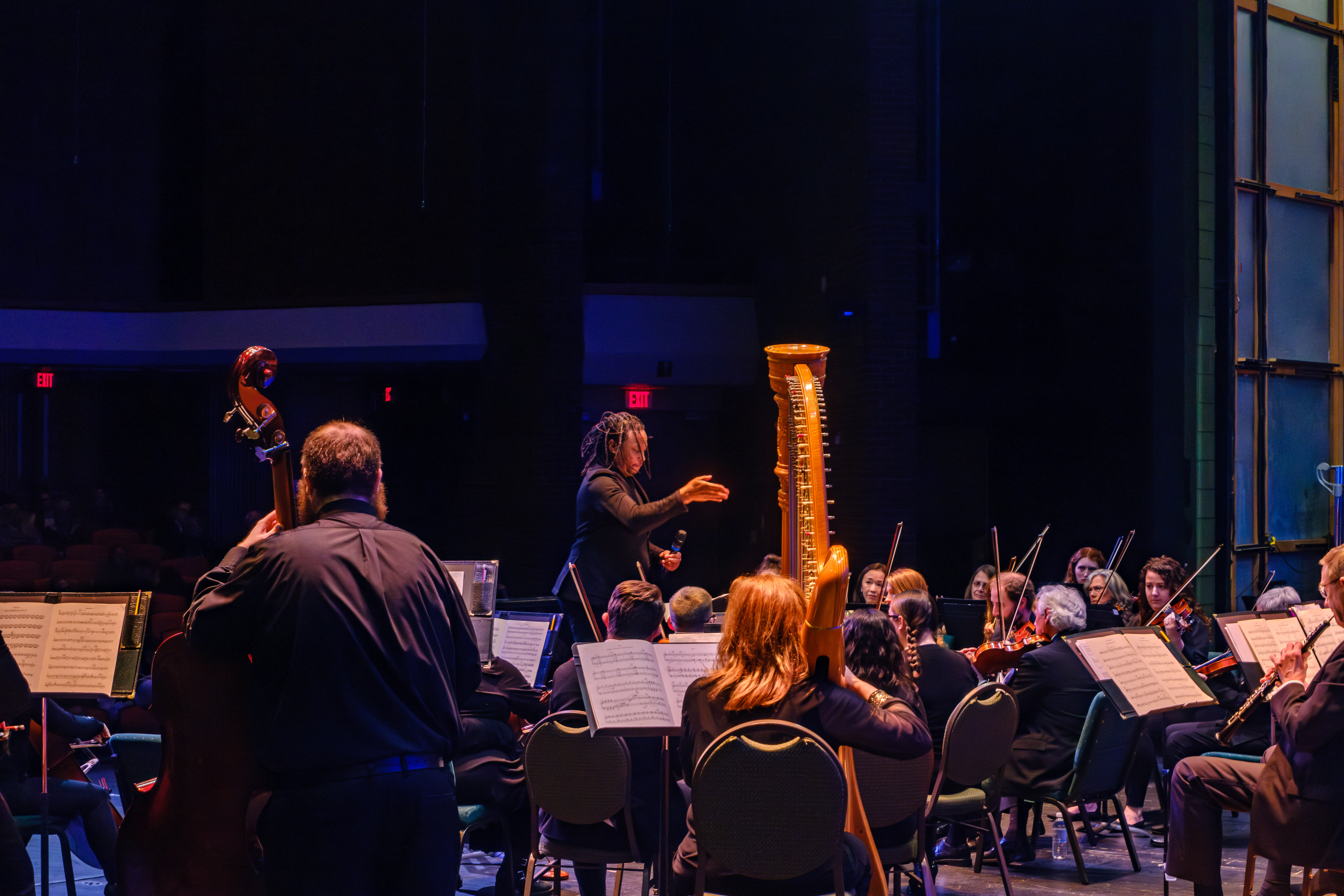
When Barr launched the Catalyzing Vitality initiative, we sought to offer support to an often overlooked part of the Massachusetts arts ecosystem: our hyper-local, community-based arts organizations. Within this portfolio, there are 54 arts organizations whose commitment to artistic development, partnership, experimentation, and the celebration of cultural heritage enlivens the Commonwealth, with several of these organizations claiming titles such as “first,” “only,” and “largest.” Below, we shine a light on five classical music organizations that are challenging narratives about what classical music is and who it is for — each is paving the way to bring classical music to wider, more diverse audiences.
Lowering the barriers to listening
A few years ago, conductor and musician Orlando Cela asked a particularly talented young flute student at UMass-Lowell to run through a popular piece well-known in the orchestral world. To his surprise, she didn’t know it. “She told me it’s because she had never seen an orchestra live before,” he says. Her reasons were numerous — the expense of tickets, the long drive from Lowell to Boston, plus the added cost of parking. “I’m poor,” she told him.
That’s when an idea crystallized in Cela’s mind. Why not “bring” an orchestra to his students?
Like that, in 2019, the Lowell Chamber Orchestra was born. Now in its seventh season, the professional orchestra of top-tier musicians provides high-quality music right in the community. Best of all, it’s free. “Anyone can come in from the street,” says Cela, who is also an assistant professor at Berklee College of Music and music director of the Arlington Philharmonic Orchestra.
Since the founding of the Lowell Chamber Orchestra, Lowell’s isolation on the classical music scene has been fading. Now Lowell residents can see top-level concerts without barriers. While it performs classical standards by composers like Mozart, Bartok, Haydn, and Stravinsky, it also plays works by acclaimed yet lesser-known artists of color and women. In addition, it runs an international competition for composers and performers under 30, highlighting the work of young artists seeking a toehold in the field.
In 2025, a Brazilian composer, Helder Alves de Oliveira, won the competition and flew in from Rio de Janeiro to hear, for the first time, a professional orchestra perform his piece. “He was over the top that a professional orchestra played it, and the audience was there to hear this new piece,” says Cela. “At the same time, we played a very standard piece of repertoire. So, the folks who come in to listen to the music they like are also learning about new music. And again, all for free.”
The greatest impediment so far, says Cela, has been in obtaining the funding necessary to pay best-in-class musicians (some of whom perform with The Boston Pops and the New Hampshire Philharmonic Orchestra). “We’re in an immediate need for funding for next season to make sure that we can keep our promises,” he says. Despite these difficulties, it’s clear that Cela’s light-bulb idea is having an effect around the city. Cela can tell by the remarks of some who have attended performances. Responding to a questionnaire sent around after a performance, one person wrote: “I never thought this was going to be as exciting as it was.”
Moving into the community
Although the Fall River Symphony Orchestra is New England’s oldest community orchestra, it is wrestling with a surprising problem: visibility.
It was most evident last summer, when the orchestra held a concert at Fall River’s waterfront celebrating its centennial anniversary. When the audience was asked if they’d ever heard of the Fall River Symphony Orchestra, “a lot of people didn’t know it!” says Elizabeth Doherty, board member. “We’ve been here for 101 years, but still, you have people who are not new to the community saying, ‘Oh, I didn’t know that Fall River had an orchestra.” That’s a problem the orchestra is intent on fixing.
Daniels wants to continue performing concerts in public spaces even though the idea has been controversial. (In fact, several board members quit after the 2025 concert at the waterfront, citing cost concerns.) “It was outside of our comfort zone,” muses Daniels. “It was a culture shift.” And yet, says Daniels, it is exactly these kinds of uncomfortable changes that need to happen to keep the orchestra relevant.
“If I had my druthers, I would love to play on the marina every year,” he says. “The more exposure we get, the better we can serve the community. And that’s what we’re here for.”
He’s mulling over ways to help fund more public concerts, but a difficult truth is that the orchestra’s volunteer nature itself hinders exposure. It’s tough, Doherty says, to ask musicians to commit to a heavy performance schedule when they balance day jobs. But Daniels, who is also an assistant professor at Berklee and an adjunct lecturer at Tufts, is always looking for new ideas. One of them has been to partner with Fall River’s Durfee High School.
The partnership has accomplished several goals at once, including broadening the orchestra’s reach by recruiting young players who reflect the city’s diverse demographics. When they perform, these players attract their own friends and family who become new patrons. A Durfee High School music teacher, Julia Klingner, is now working as the orchestra’s assistant conductor. She’s also recruited a half-dozen high school students into the orchestra’s fold. “We really have some fabulous musicians,” says Daniels. “When you work with a group for as long as I have and you have those core players that are there week in and week out, there’s a synergy that develops…a bit of electricity. I’m so proud of the fact that we can harness such electricity.”
Demystifying perceptions of classical music
A common narrative has defined classical music as elitist, exclusive, and white. But Cailin Marcel Manson, artistic director and chief executive officer of the New England Repertory Orchestra (NERO), based in Springfield, has a different take. “Classical music has always been narrativized as ‘high art, must go to a temple of culture to see it,’ says Manson. “But what I found in my own experience growing up is that classical music has actually not been that. Somewhere we bought into that lie.”
That’s why Manson, professor of practice in music and director of music performance at Clark University in Worcester, as well as chair of vocal studies at the Longy School of Music of Bard College in Cambridge, founded NERO in 2021. Its mission, says Manson, is to diversify the classical music canon, create more professional pathways for musicians of color, and “demystify” the conception of what classical music is. “Classical music in America has never been as white as it is perceived to be,” he says.
For decades, musically rigorous classical groups have performed at Historically Black Colleges and Universities, community orchestras, and churches, thanks to a vast and vibrant ecosystem of community organizations. NERO exists to act as a nexus for all that talent.
An example of how it can come together happened during the orchestra’s last season, at a concert featuring a cantata based on the life of abolitionist Frederick Douglass. The concert was held at Mechanics Hall in Worcester in honor of a series of portraits of celebrated 19th-century Worcester leaders, many of them African American. It drew attention not only to the work of the late Rutland composer Brian Story but also to that of Nkeiru Okoye, a composer of Nigerian and African American descent, on which Story based his piece.
The event drew a large and diverse audience. “We’re performing this amazing piece, and I think that was probably maybe the most diverse audience we’ve had for anything,” says Manson. In addition to community leaders, several descendants of Frederick Douglass also jammed the 1500-seat theatre. “That’s the sweet spot,” says Manson.
“Doing work that’s compelling, whether it’s traditional or new, having a community participative aspect, and then finding a way to have that draw more diverse interest and participation in the actual performing of the work itself.”
Preparing a new generation of musicians
While regional and community orchestras experiment with ways to broaden the canon, cultivate new audiences, and create performance opportunities for musicians, other organizations are working to nurture the next generation of classical musicians.
In Brockton, Greg Fernandes, founder of the Rose Conservatory, an after-school music education program for children, says it’s important to give young musicians, particularly musicians of color, a chance to see other kids like themselves on stage. Fernandes knows intimately why this is important. A trained opera singer and accomplished violinist, he is of Cape Verdean ancestry. For a while, he gave up the violin because, he says, “I was the only person that looked like me.”
At the Rose, there’s no risk of that happening. A diverse group of students, from kindergarten through high school, learn a range of instruments. Professional artists of color come to speak with the kids. And the kids themselves put on two major concerts a year. They get the same attention, encouragement, rigor, and artistic freedom that kids in the elite school where Fernandes once taught routinely receive. Their time at the Rose helps them to develop confidence, discipline, collaboration skills, cultural awareness, and a stronger sense of belonging.
“I think that if I had had somewhere like The Rose as a kid, it would’ve motivated me more to continue what I’m doing,” he says. “I still have friends that don’t even know that music is my thing even today, because I hid my talents from a lot of people.”
Orice Jenkins, executive director of Música Franklin in Greenfield, is also hoping his after-school music program can provide a nurturing space to children growing up in households with limited resources. As students learn to sing, drum, and play the violin, viola, cello, and bass, they also build language and memory skills, focus, and determination.
While they are introduced to many musical genres, including classical music, there is much more at play than musical proficiency. “Professional music is so serious and so difficult, and it’s hard when you have kids that have been going through the worst of the worst that you can imagine,“ says Jenkins, a singer-songwriter and trained string player. “I just want to make sure that they’re having a fun time first and that they’re safe.”
His work at Música Franklin, taken along with the other bold experiments unfolding in the Massachusetts classical music space, is just one example of how art can bridge gaps, bring people together, and sustain communities. While classical music is often about performing works that are centuries old, it couldn’t feel more of this moment. As arts leaders continue to find new ways to connect with audiences, they invite us all to support organizations that keep those connections alive. The arts, after all, are not only a reflection of our communities—they are a vital force in strengthening them.