
Most people believe a foundation’s job is to grant money. Which is true—for the most part.
More than granting resources, I believe that philanthropy is supposed to work in partnership with communities to devise strategies to help make the world a better place for everyone. In other words, informed by the people and communities we work alongside, a foundation’s purpose is to help make sense of the world and create the conditions for change makers to lead.
For me, making sense to make change begins with understanding how systems are impacting people and what people ultimately need for their communities to thrive. Which is, precisely, what I began to see when I sat down with students, teachers and community leaders in March. Our journey began at 15 Union Street in Lawrence, MA. It is one of those incredible old mill buildings along the Merrimack River, with a deep history and, these days, a profound future.
The original structure was built between 1846-1848 as a machine shop. In 1909 the textile company Everett Mills converted the machine shop into a massive 525,000-square-foot complex. It was one of the largest cotton mills of its time, employing some 2,100 people.
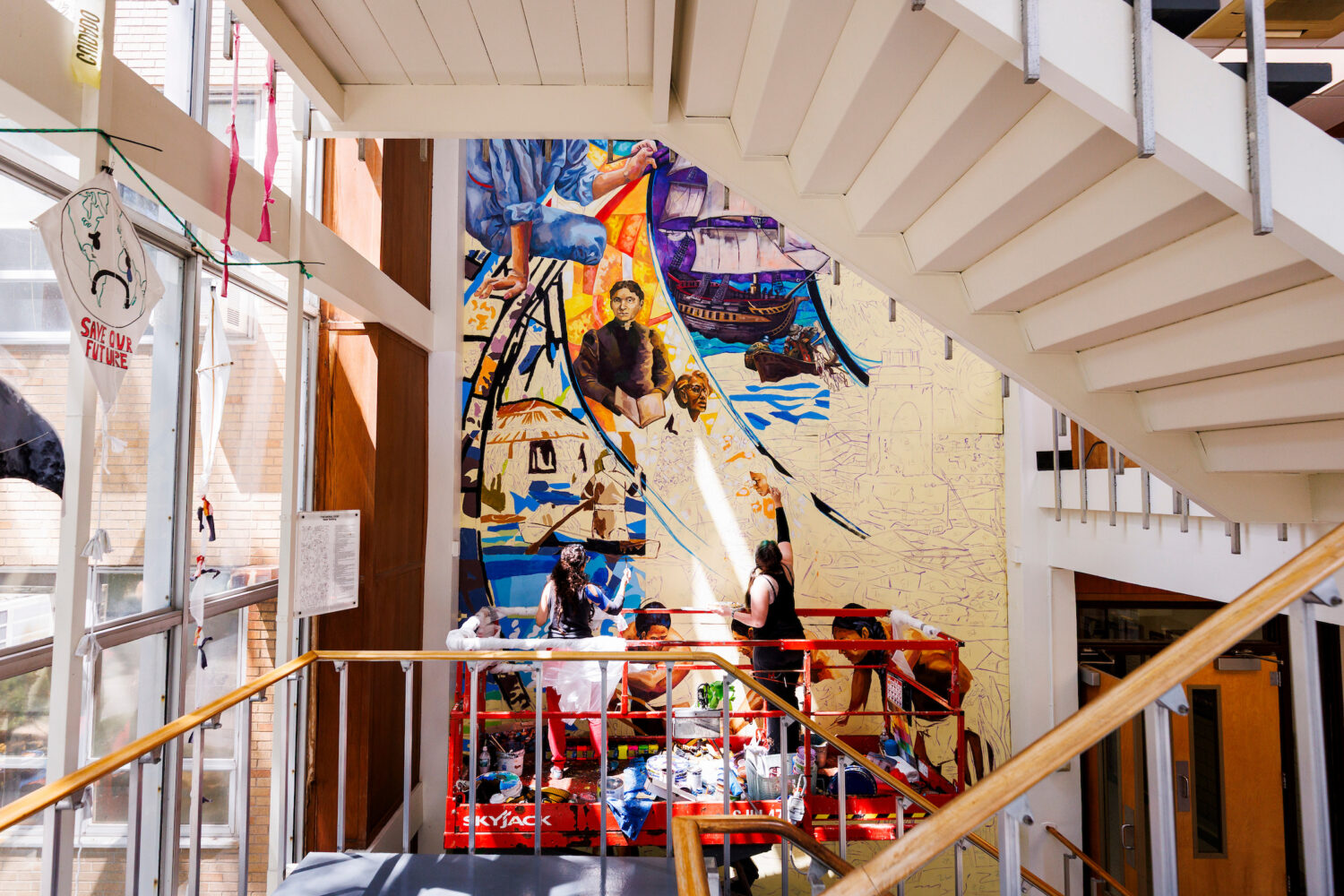
Three years later, in 1912, 15 Union Street was the starting point of the pivotal Bread and Roses strike, where thousands of mostly female immigrant workers walked out to protest wage cuts. Renowned for uniting diverse immigrant groups, the Bread and Roses strike demanded both better pay (bread) and better working conditions (roses), ultimately winning significant wage increases and lasting labor reforms. These immigrant women changed the system that was directly impacting their lives.

Once textile manufacturing left the commonwealth, like so many mill buildings along the Merrimack, 15 Union fell into disrepair. Around the turn of the century, community organizations, including Groundwork Lawrence, came together to develop a plan to recapture the beauty and the history of 15 Union, in order to shape a better future for Lawrence. Redeveloped in 2011, the deep red brick building is now home to a range of organizations, restaurants, and businesses, a formidable symbol of Lawrence’s emergence from what Boston Magazine once called “the city of the damned.”
So, I should not have been surprised when I stepped out of the elevator on the 6th floor of 15 Union and into a bright sunny room with soaring ceilings that house the offices of Elevated Thought. Our group gathered around Marquis Victor, founder and executive director of Elevated Thought, for a tour. Before we walked out of the main gallery, he pointed to the science fiction inspired art on the wall. Referring to the dystopian and aspirational elements of the pieces that offered young people’s view of the world, Marquis said, “We are living through a dying system that is lashing out because it is dying.”
The legacy of the immigrant women that led the Bread and Roses strike of 1912 lives on at 15 Union Street — it remains a place where systems are challenged, reimagined and, eventually, reborn.
Over the course of my first months in my role as president of Barr, I have gotten to know the incredible staff of the foundation, and talked to funders, elected officials and grantees across Massachusetts, into Rhode Island and up to Maine. We are all grappling with the reality that imperfect systems that we would push and prod to educate young people, protect our climate or support the arts sector, have been weaponized to undermine, oppose and vilify our communities and our work.
Today, I’m inspired by this community of leaders eager to work together to confront the challenges society faces, imagine systems for a future we don’t entirely understand, energized by what is possible, curious to learn more, ready to ask a better set of questions. These are among the values we hold dear at the Barr Foundation.
At Lowell High School, that ability to ask better questions is being developed by teachers testing new models of instruction. I saw classrooms of young people from around the world working together to learn English, to understand genetics, to pursue their aspirations. They asked tough questions, they respectfully challenged authority, they understood that working together was a key to success. The portrait of these soon to be graduates were of students with the poise, confidence and discernment to take on the world.
Down the street, at Western Avenue Studios, hundreds of artists have come together with the Arts and Business Council of Greater Boston to reclaim an industrial space. They have created one of the largest artists communities in New England and it is home to Angkor Dance Troupe.
Angkor Dance traces its lineage to the terror of the Khmer Rouge genocide — killing nearly two million Cambodians — including approximately 90% of Cambodia’s classical artists, pushing the rich traditions of Khmer dance and music to the brink of extinction. Through the Refugee Act of 1980, 30,000 Cambodians made their new home in Lowell, MA, forming what remains the second largest Cambodian community in the US. Under the guidance of founder and master teacher, Tim Chan Thou, the Angkor Dance Troupe is a testament to what it looks like when leaders ask new questions.
With a mission of preservation, education, and innovation, Angkor Dance has blended Western ballet with Cambodia’s Robam Kenore traditional dance style to produce a first in the nation show, Khmer Swan Lake — which launches a three-week run at the Merrimack Repertory Theater through April of 2026. The production includes dancers who were raised in Lowell — many of whom were reintroduced to this aspect of their culture at Lowell’s Butler Middle School — as well as dancers from across the country who sought to join the Troupe in this re-imagining of the future.

Our time with the Troupe led me to think about coming back to the region a bit differently. When I left Boston in the Spring of 2008, I was in my 30’s and thought I could take on the world. Twenty years later, whether or not I have matured is up for debate. But I am an old man girl dad, married to a lovely, brilliant and exceedingly patient woman. While I will never be accused of being a dancer, getting a sneak preview of Khmer Swan Lake that day resonated deeply. It reminded me of why it is so important to strike the balance between preserving what is important, strengthening the bonds that hold us together and exploring new stories and places.
All to say, do I have a stake in the future? Of course. But I believe for us to reimagine systems for a future we don’t always understand, we need to cultivate leaders that have a generational stake in that future, leaders whose sense of civic pride transcends the anger of the dying systems around us.
Which is what I found in Lawrence.
Groundwork Lawrence has been at the leading edge of community resilience and redevelopment for 27 years. Working with partners across the region, including the Essex County Community Foundation, Groundwork and their partners have refused to allow Lawrence to wither away. Understandably, the people of Lawrence took the “city of the damned” headline quite personally.
As we sat and chatted with Lesly Melendez, Executive Director, Groundwork Lawrence and Stratton Lloyd, President & CEO, Essex County Community Foundation, about the critical work they were leading, I asked one of younger staff people in the room, Sara Morin, Groundwork’s newly promoted development director, what she thought.
Sara was born in Guatemala City, Guatemala, and was adopted at 8 months old. Growing up in Lawrence, her grandparents taught her about the community around her, developing her love of history. The pride she had in Lawrence came through as she talked about Groundwork and all the community work she did in her free time.
Almost as an aside in the conversation, Sara mentioned that she served as chair of Lawrence History Center — after earning her Master’s degree in Museum Studies from Harvard University’s Extension School. As I listened to the energy with which Sara spoke of the past, present and future of her community, I realized she has one foot firmly planted in the history of Lawrence, with the other stepping into designing and developing the future of Lawrence through her work at Groundwork. Sara was making sense of the past, while making changes for the future.
So, let’s go back to Elevated Thought. Marquis had finished the tour — of 18,000 sq ft if you recall — and we were breaking for lunch. While I was waiting for the sandwiches to arrive, I saw Michael. Sitting alone in the center of the room in his Elevated Thought sweatshirt, looking at his phone. I sat down, stuck out my hand, “Hey, my name is Ali.” Michael and I talked for an hour.

Michael was born in Lawrence. His mom is from Dominican Republic; he lives with her and his grandmother. Growing up, his mom realized that the career track Greater Lawrence Tech had put him on to become a well-paid plumber was, as he described it, “off.” So, she encouraged him to do something he loved – and he loved telling stories, filming his friends with his phone.
In his sophomore year, he transferred to Graphic Communications. Soon, a friend told Michael about Elevated Thought and he started going to their afterhours programming, honing his filmmaking skills. Today, Michael is on staff at Elevated Thought, teaching young people how to film, edit, and tell their stories.
On top of all that, his own film projects tell the story of Lawrence through his eyes. Check out Bailando on Film Freeway to see Michael’s vision of a vibrant future as captured in his films. Now, much to his amusement, Michael hears his mother on the phone, telling her friends that “my son’s in Hollywood” working on film projects.
As I’ve been getting to know the people, organizations, and community partners we work with across New England, I’m excited by the pipeline of leaders who are asking better questions. That pipeline reflects family histories from across New England, the country and around the world.
Over the course of one day along the Merrimack River, I saw how teachers, artists, students, and community-centered real estate developers are making sense of the time we live in, recognizing the systems that were dying, reimagining what they could look like and doing the hard work to bring something better to life. These are institutions and leaders the community trusts and they are working together because the challenges are too great, the potential too vast, for any one organization or person to make our future.
If I’ve learned one thing over my career it is that working together as a community—inter-generationally, across sectors, spanning ideologies—is the clearest path forward. This is what philanthropy should do to help create the future we need to see.