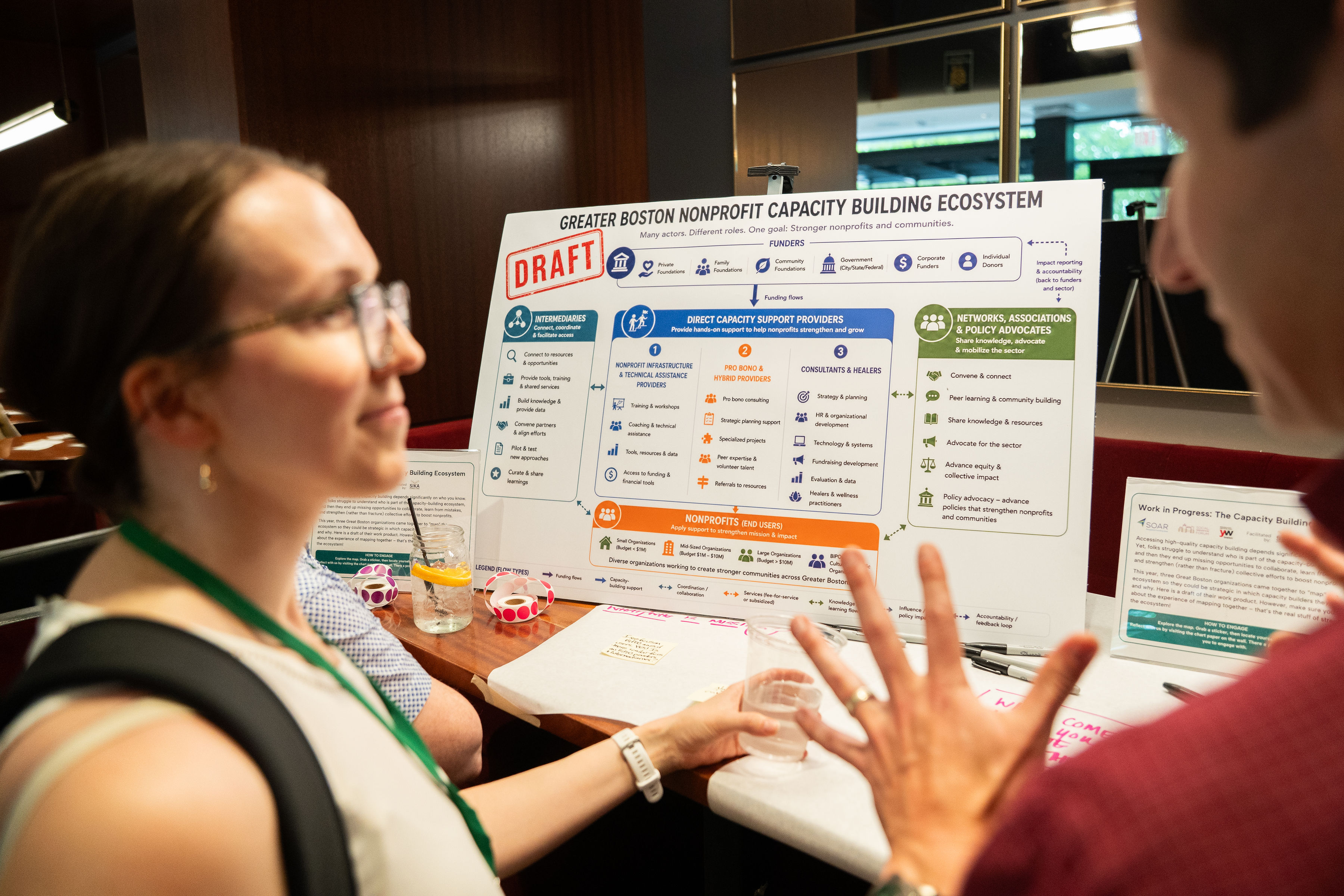
Funders have long offered capacity building and other beyond-the-grant support to help nonprofits strengthen their organizations. But in our resource-constrained environment – a time when the stakes for nonprofits have never been higher – making support available isn’t the same as making it usable.
At Barr, we’ve been working with nonprofit leaders, capacity building providers, and peer funders to understand this gap. Nonprofits are navigating difficult decisions with limited staff, time, and resources. Support intended to help them meet those challenges can inadvertently become another demand on their capacity.
This support is not a substitute for funding. But when funders offer it, we want it to make a meaningful difference. That means asking not only what nonprofits need, but also what it will take for them to access and use the help. Here are a few things we’re learning.
Lesson 1: More support for grantees isn’t translating into more participation
Through our partners at Systems Design Lab, we interviewed over a dozen funders from across Greater Boston about their approaches to capacity building. Many described increasingly intentional offerings, earnestly meant to meet the demands of our current operating context – from technical assistance and financial management support to resources for staff well-being. Yet many also reported lower-than-expected participation, leaving some funders struggling with what to do.
What’s going on here? These conversations prompted us to look more closely at the fit between what funders are offering and what nonprofit leaders are seeking. Across our interviewees, nonprofit leaders emphasized fundraising, strategic communications, and advocacy, while funders emphasized financial management, leadership coaching, and peer convening. This echoes the Center for Effective Philanthropy’s recent finding that beyond-the-grant support is frequently mismatched to nonprofits’ needs.

Don’t miss the point here: each of these forms of support can be valuable. And most foundations are offering their grantees capacity support on top of direct funding. But the differences suggest that funder offerings may not always reflect nonprofits’ most pressing priorities. A resource that a funder sees as important for long-term organizational health may not address the challenge occupying a nonprofit leader’s attention today.
The lesson, then, is not that funders should abandon one type of support in favor of another. It is that we need to keep listening—and be willing to adjust what we offer as needs change.
But relevance is only part of the picture. Even useful support can go unused if taking advantage of it requires time and attention that an organization simply does not have.
Lesson 2: Getting help takes capacity
Nonprofit leaders are managing shortages of staff, time, and resources. And they’re doing so while also making consequential decisions about the future of their organizations. In this context, finding a provider, weighing options, completing an intake process, or scheduling sessions can become another item on an already crowded to-do list.
This creates a paradox: the organizations that could benefit from support may have the least capacity to pursue it.
Low participation, then, is not necessarily evidence that a resource lacks value. It may signal a mismatch in priorities, an overly demanding process, or simply a moment when a leader cannot make room for one more commitment. We need to understand what is getting in the way before deciding what participation tells us.
Recent work we commissioned with ideas42 points to practical ways to ease that burden: make the benefit and time commitment clear, communicate opportunities well in advance, simplify the next step, and reduce unnecessary decisions.
These changes do not remove the time required to engage meaningfully in capacity building. But they can reduce the effort required to get started. The goal is to make participation easier without taking away grantees’ ability to shape the support they receive.
Lesson 3: Tailor support models to meet grantee needs
Coaching offers a useful example of how relevance, access, and relationships intersect.
Social sector practitioners recognize the value of pairing group or cohort capacity building with individual coaching. In conversations with three Greater Boston funders, we explored different ways of offering coaching: one funder provides a designated coach, another offers several coaches to choose from, and a third funder matches leaders with a coach based on their stated needs.
Our interviews did not point to there being one magic trick in this work; no single arrangement worked for everyone. Instead, the interviews highlighted the importance of understanding the leader’s circumstances—and considering which aspects of arranging support could be something the funder could take off of their grantee’s plate.
A leader who already has a trusted coach may simply need funding to continue that relationship. Another may welcome a choice of providers. Someone else may benefit most from a thoughtful introduction, rather than a list of people to research and contact.
The question is not simply how much choice to offer. It is how to preserve meaningful choice while reducing the work required to act on it.

That requires relationships, judgment, and a willingness to adapt. It can also require more time or resources from funders, whether they arrange support themselves or partner with someone who can. Funders face bandwidth constraints, too. But reducing the burden on grantees does not necessarily eliminate the work; it changes who does it.
Putting it all together: Ask who does the work
Across our conversations, we keep returning to a central lesson: effective support has to be designed around the full experience of accessing and using it, not simply around whether the resource exists. Funders, we have to put ourselves in our grantees’ shoes: what must a leader do to find support, assess its relevance, connect with a provider, and put it to use? What time and effort will the work require from the broader team? Where is that effort essential, and where could we make it easier?
Funders do not have to work through these questions alone. Sharing what we are trying, where participation has been lower than expected, and what grantees are telling us can help us strengthen our offerings and identify opportunities to coordinate rather than add to the demands on nonprofits.
Reimagining capacity building is not about finding a single model that works for everyone. It is about making deliberate choices, in conversation with grantees, about what help looks like, what it requires, and who does the work.
A useful place to start: What will it take for grantees to access this support and put it into practice—and what could we change or take on to make that possible?
Interested in our efforts to improve capacity building?